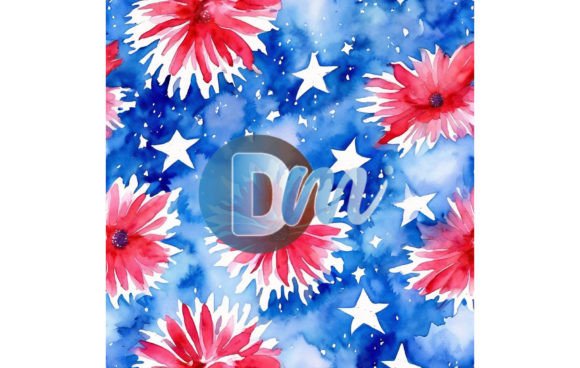
4th of July Seamless Pattern 117: A Designer’s Asset for Festive Visual Identity
When Independence Day approaches, designers, business owners, and creators begin the annual scramble to produce fresh, patriotic visuals. The market fills with flags, fireworks, and star-spangled banners, but standing out requires more than a simple red-white-and-blue color scheme. Enter 4th of July Seamless Pattern 117—a repeatable design element that balances tradition with modern aesthetic flexibility. This pattern is not merely a decorative afterthought; it functions as a foundational visual unit capable of anchoring an entire campaign, product line, or digital experience. Understanding its characteristics, applications, and workflow integration can help professionals and hobbyists alike elevate their festive projects without reinventing the graphic wheel.
The Visual Language of Independence Day: How a Single Pattern Sets the Tone
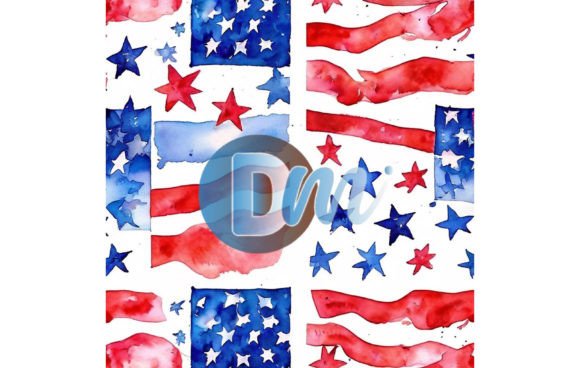
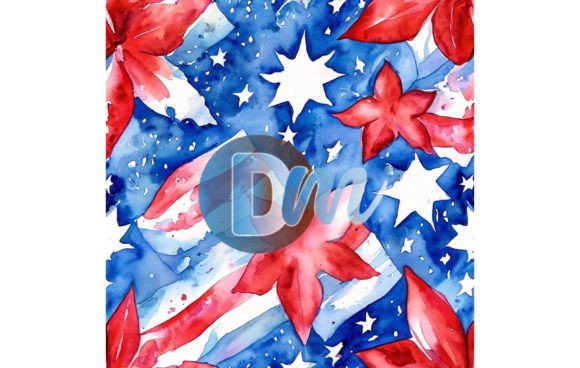
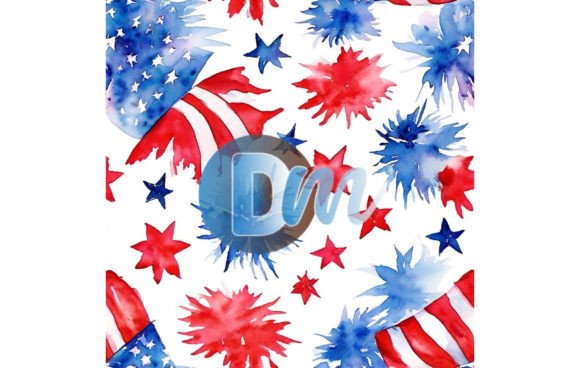
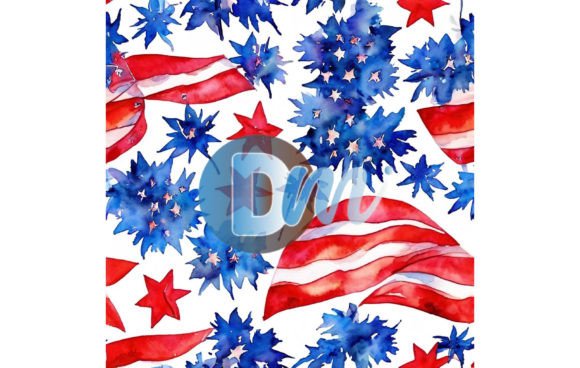
Patterns carry emotional and cultural weight. A seamless pattern designed for July 4th must evoke celebration, unity, and nostalgia without becoming visually cluttered. 4th of July Seamless Pattern 117 achieves this by layering classic American iconography—stars, stripes, and subtle burst motifs—into a repeating grid that works across scales. Whether printed on a banner or displayed as a website background, the pattern maintains readability and coherence. This is critical because festive design often suffers from overstimulation; a well-constructed pattern provides a controlled visual rhythm that guides the eye rather than overwhelming it. Designers familiar with pattern libraries know that a single versatile tile can save hours of manual repetition, and this particular pattern delivers that efficiency without sacrificing thematic punch.
Core Characteristics That Define 4th of July Seamless Pattern 117
Several structural features make this pattern stand out among generic holiday textures. First, the tiling is mathematically precise—edges align perfectly whether the pattern is used in a 100×100 pixel swatch or scaled to a 10-foot vinyl wrap. Second, the color palette adheres to traditional patriotic hues (deep navy, bright crimson, and clean white) but with enough saturation flexibility to adapt to both print and screen. Third, the motif density is moderate: enough visual interest to read as a deliberate design, but not so dense that text or foreground elements get lost. Fourth, the pattern includes subtle star field variations that prevent monotony across large applications. These characteristics mean that 4th of July Seamless Pattern 117 can serve as both a primary background and a secondary accent, depending on how it is layered and scaled.
Practical Applications Across Industries and Mediums
The real value of any seamless pattern lies in its versatility across use cases. Here are several ways different professionals integrate this specific design into their work.
Event and Hospitality Branding
For event planners organizing block parties, corporate picnics, or municipal fireworks displays, cohesive visual identity matters. A single pattern applied to signage, table runners, wristbands, and digital invitations creates instant recognition. 4th of July Seamless Pattern 117 works well as a repeating background on banners and stage backdrops, where its moderate density ensures that event logos and schedules remain legible. Catering companies have used the pattern as a liner for dessert boxes or as a print on disposable napkins, adding a professional touch to temporary setups.
Retail and Product Packaging
Small business owners launching limited-edition July 4th products—such as candles, soaps, or snack boxes—often need packaging that communicates festivity without resorting to clichés. The pattern wraps cleanly around cylindrical labels, box lids, and tissue paper. Because the tiling is seamless, manufacturing partners can repeat it across runs without alignment issues. One observed trend is the use of 4th of July Seamless Pattern 117 as a subtle interior liner for gift bags, visible only when the recipient opens the package—a small surprise that elevates unboxing experience.
Digital Design and Web Assets
Web developers and UI designers often need thematic backgrounds that do not distract from content. The pattern’s balanced contrast works as a full-page background on landing pages, email headers, or social media carousels. When scaled down, it functions as a texture overlay on buttons or divider lines. A common implementation is to set the pattern at 30–50 percent opacity behind hero sections, allowing festive flair without compromising text accessibility. Additionally, because it is a true seamless tile, loading times remain efficient—only one small image file is needed to tile across any screen width.
Textile and Apparel Design
Print-on-demand entrepreneurs and fabric designers value patterns that translate well to different fabric weaves. The repeating structure of this pattern prints cleanly on cotton, polyester, and linen blends. T-shirts, scrunchies, tote bags, and bandanas benefit from the pattern’s non-directional orientation—consumers do not need to worry about the pattern hanging upside down. Several small fashion brands have used 4th of July Seamless Pattern 117 as an all-over print for kids’ clothing, where the playful star motifs resonate with young wearers and parents alike.
Educational and Community Resources
Teachers and community organizers often create worksheets, bulletin boards, or parade materials on tight budgets. The pattern can be printed as a border for flyers, or used as a background for classroom activities about American symbols. In one observed example, a local history museum used the pattern as a backdrop for a children’s scavenger hunt worksheet, reinforcing the holiday theme without additional illustration costs. This application highlights the pattern’s accessibility—it does not require advanced design software to implement.
Why Creators and Business Owners Are Adopting This Pattern
The decision to adopt a specific seamless pattern often comes down to return on creative investment. 4th of July Seamless Pattern 117 reduces the need for custom illustration for each project, allowing creators to focus on messaging, product quality, and user experience. For business owners, the pattern offers brand consistency across multiple touchpoints—if a café uses the same pattern on its window decal, menu inserts, and tote bags, customers internalize a cohesive holiday identity. From a production standpoint, the pattern’s tile size and resolution are optimized for both small-scale home printing and commercial offset runs, meaning it scales with the user’s infrastructure. Hobbyists appreciate that the pattern works within free or low-cost design tools like Canva, GIMP, or Cricut Design Space, lowering the barrier to professional-looking results.
Integrating the Pattern into Digital and Print Workflows
Practical integration varies by medium, but general principles apply across workflows. In graphic design software, importing the pattern as a swatch allows instant fill of any shape, text box, or artboard. For print projects, users should verify that the pattern’s embedded resolution matches the output device—300 DPI for most commercial printers, and 150 DPI for large-format banners. When used digitally, exporting the pattern as a scalable vector tile ensures crisp rendering on retina screens. One observed workflow involves designers creating a library of pattern variations: scaling the original by 50 percent for subtle texture, rotating it 45 degrees for diagonal interest, or layering it with a semi-transparent white overlay for lighter applications. These modifications are possible because the pattern’s base structure remains stable under transformation.
For physical products, production partners typically require a repeatable tile in a specific format (PNG, TIFF, or vector EPS). 4th of July Seamless Pattern 117 is typically delivered as a square tile with no visible seams, making submission straightforward. It is advisable to test a small print sample before full production to check color shifts—especially red, which can vary significantly between screen calibration and ink output. Users working with fabric should also consider pattern scale relative to the garment; a large repeat may look overwhelming on a small pocket but perfect on a dress.
Considerations When Scaling and Customizing the Design
No pattern is a magic bullet, and thoughtful customization is often needed to match specific project requirements. One consideration is contrast. While the pattern’s navy-and-crimson combination is visually striking, overlaying dark text directly on the unmodified pattern can reduce readability. The solution involves either increasing the pattern’s brightness, adding a subtle drop shadow to text, or using a white or light-colored block behind copy. Another consideration is cultural sensitivity. Some audiences may prefer a more subdued patriotic expression; in such cases, scaling the pattern to a micro-texture or using it only as an accent rather than a dominant element can strike a respectful tone.
Scale manipulation is another factor. A pattern that looks elegant on a business card may appear chaotic on a large banner if not resized appropriately. Designers should test the pattern at multiple scales: small for intimate items like stickers and stationery, medium for apparel, and large for environment graphics. Because 4th of July Seamless Pattern 117 is built from distinct motifs rather than abstract noise, scaling up reveals the individual stars and stripes more clearly, which can be desirable or distracting depending on the context. Sampling the pattern on a mockup before finalizing the design is a best practice.
Trends in Festive Design: The Role of Repeating Motifs
The design industry has moved away from isolated, static graphics toward systems thinking—where one asset flexes across multiple formats and sizes. Seamless patterns are a key part of this trend. 4th of July Seamless Pattern 117 aligns with the broader shift toward modular design systems that prioritize consistency and reusability. In 2024 and beyond, audiences expect brand experiences that feel cohesive across physical and digital spaces, and repeating motifs provide that visual glue.
Another observed trend is nostalgia-infused modernism: traditional symbols rendered with clean lines and balanced compositions. This pattern bridges that gap by preserving familiar iconography while avoiding overly ornate or vintage-heavy styling. The result is a pattern that feels appropriate for both a craft fair and a corporate event. Additionally, as sustainability becomes a priority in packaging and event materials, using a single efficient pattern reduces print waste—fewer test prints, less variation between runs, and longer lifespan for the design asset.
Observations from Real-World Implementation
Across various user testimonials and shared case studies, a few consistent observations emerge. Users frequently note that the pattern’s mid-density is its strongest asset—it fills space without competing with foreground content. One small business owner reported using 4th of July Seamless Pattern 117 on booth banners, product labels, and social media templates with zero additional design work beyond color tweaks. Another creator mentioned that the pattern held up well under extreme scaling: at 600 percent, the motifs remained recognizable and aesthetically pleasing, which is not true of all seamless tiles. These experiences underscore the pattern’s engineered reliability.
From a pedagogical angle, educators using the pattern in design courses have highlighted it as an example of effective tile construction—showing students how motif distribution, edge matching, and color balance combine to create a functional repeat. This dual role as both a production tool and a teaching resource adds another layer of value for institutional users.
Ultimately, whether you are wrapping a gift box, designing a website, or stitching a quilt, 4th of July Seamless Pattern 117 offers a ready-made foundation that respects your time and amplifies your creative intent. Its strength lies not in novelty, but in dependable repeatability—the quiet power of a pattern that works so well you forget it is there, even as it shapes the entire visual experience.